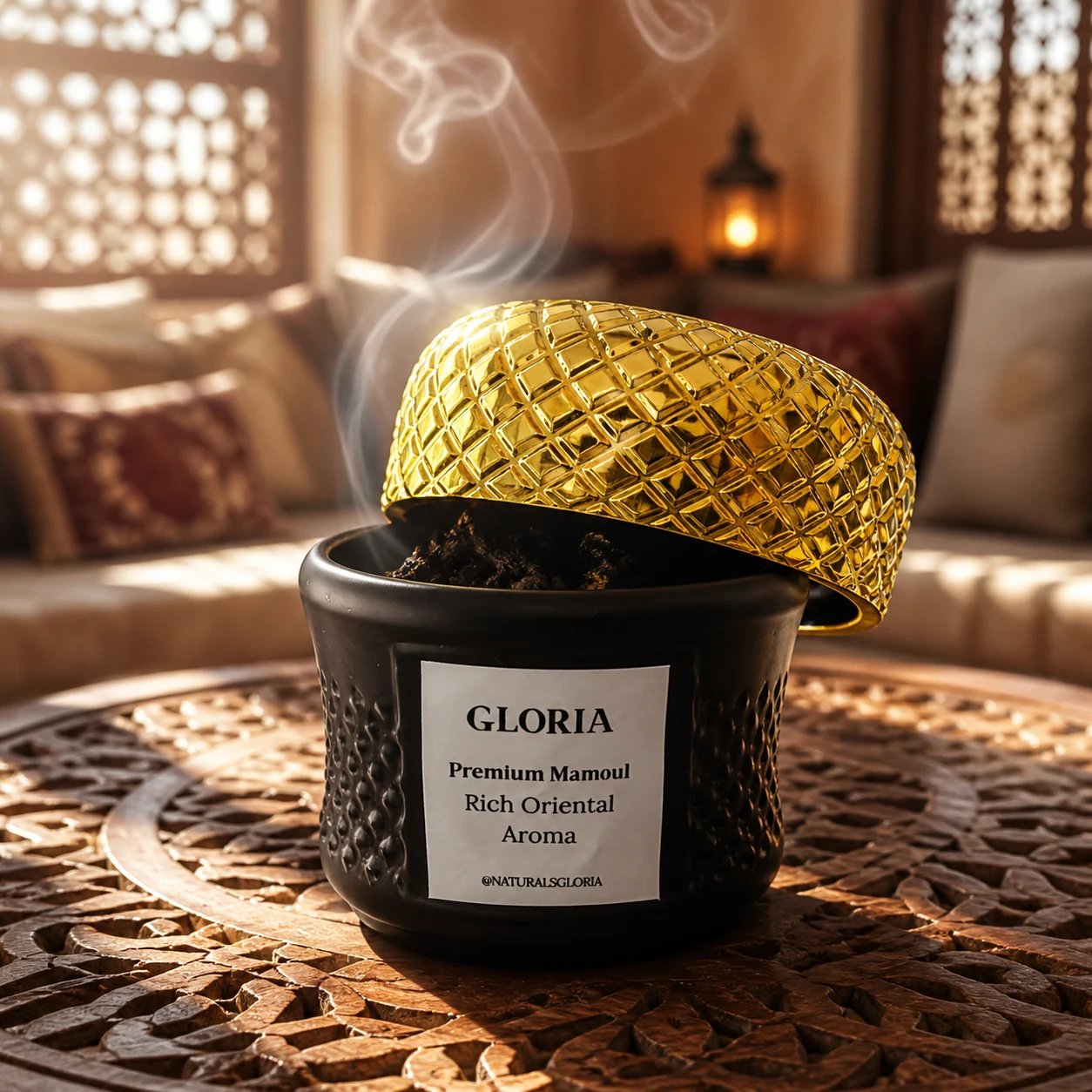
Bakhoor is scented incense, usually wood chips or small blended pieces carrying fragrance oils and resins, that you heat on charcoal or an electric burner to perfume a room and the fabrics in it. To use it, wait until a charcoal disc stops sparking and turns evenly grey, or set an electric burner to low, then add two or three small pieces and let the scent build slowly. Choosing the best bakhoor mostly comes down to one question: do you want a rounded, gently sweet scent for family and guests, or a dry, smoky oud for the majlis?
What bakhoor is, and what the names on the jar mean
Bakhoor is made to be heated, not worn. As it warms, it releases scent into the air, and that scent settles into curtains, cushions and clothing, where it stays long after the smoke has cleared.
Bakhoor, raw oud and perfume are not the same thing
| Raw oud chips | Bakhoor | Perfume | |
|---|---|---|---|
| What it is | Agarwood, the resin-rich wood of the agar tree, burned as it is | Wood chips or blended pieces carrying a composed scent | A liquid fragrance |
| How you use it | Heat it to scent a room and its fabrics | Heat it to scent a room and its fabrics | Apply it to skin or clothes |
| What you smell | The wood itself, which varies with origin and quality | Whatever the blend is built around, from amber and musk to smoky oud | Whatever the perfumer composed |
| Reach for it when | You want the pure character of oud | You want a particular mood in the room | You want the scent to go with you |
Good raw oud can be expensive, and it smells only of the wood; bakhoor gives you a composed scent, and much the same mood every time. For more on oud itself, see the oud tradition in the UAE.
Perfume is the only one of the three you apply to your body. Bakhoor scents rooms, fabrics and, through its smoke, hair, but it never goes on skin.
Mamoul, mubakhar and dukhoon
You will meet these words on jars and in shops. Take them as clues, not fixed categories: the same word can mean slightly different things from one seller, household or Gulf country to the next, so check the scent notes too.
- Mamoul (معمول) means "made" or "prepared", the same word as the biscuit. On bakhoor it usually points to a blend mixed and shaped into small pieces, rather than plain wood chips.
- Mubakhar (مبخر) shares a root with bakhoor and with mabkhara (مبخرة), the burner. It is often used for scented wood chips, frequently oud, though some sellers use it for any bakhoor.
- Dukhoon (دخون) comes from the Arabic word for smoke. In many Emirati homes it is simply the everyday word for bakhoor and for scenting with it; some families keep it for their own home-made blend.
Our two bakhoors carry two of these names: Premium Mamoul Bakhoor (AED 75), burned in small pieces, and Premium Oud Mubakhar Bakhoor (AED 60), burned as chips. How to choose between them is further down.
How to burn bakhoor, step by step
You need a proper burner, something heat-resistant under it, and either charcoal discs or an electric burner. Charcoal gives the traditional smoke; electric is simpler and usually less smoky. For the full comparison, see charcoal or electric bakhoor burner.
On charcoal
- Put the burner on a stable, heat-resistant surface, away from curtains, cushions and anything that can catch.
- Hold a charcoal disc with tongs over a flame, such as a gas hob or a long lighter, until it catches. Quick-lighting discs spark and crackle as they light.
- Set it in the burner and wait until it has stopped sparking and is evenly grey. Bakhoor added earlier tends to burn fast and harsh.
- Add two or three small pieces, or two if it is a smoky oud bakhoor.
- Give it a few minutes before deciding it needs more; bakhoor builds slowly. If the scent turns sharp, push the pieces to the cooler edge of the disc.
- When you finish, let the charcoal burn out in the burner with someone in the room, and empty the ash only when it is completely cold.
On an electric burner
- Place it on a flat, heat-resistant surface and set it to low.
- Add two or three pieces and give them time; electric heat releases scent more gently.
- Raise the setting one step at a time, and only if nothing is happening.
- Switch off and unplug when you finish, and wipe the plate once it is cool so old residue does not scorch next time.
How much to use, and how long it lasts
Two or three small pieces is enough for most rooms. More is not better: bakhoor builds slowly, and too many pieces is one of the two usual reasons a room turns smoky (the other is too much heat). In a small bedroom one or two may be plenty; in a large majlis, add a piece later rather than piling them on at the start.
As a guide, two or three pieces of Premium Mamoul on hot charcoal give a noticeable fragrance within minutes and hold for roughly 4 to 8 hours, depending on airflow, spreading more slowly and cleanly under air conditioning. With Premium Oud Mubakhar, start with two chips and add more only if needed.
Keep the burner out of the direct path of an AC vent or ceiling fan: a draught makes the coal burn hotter and carries the scent off before it settles.
Where and when to burn it
Bakhoor works best in a room you can air afterwards. Within that, it follows the rhythm of the house.
- The majlis, before guests arrive. Light it early enough that the heaviest smoke has thinned before the first guest sits down; the room will hold the scent all evening. In many homes the burner is also carried round so each guest can scent their kandura, ghutra or sheila, often as a sign the visit is ending. As the Gulf saying goes, after the oud, no more sitting.
- Living rooms and family evenings. A softer, sweeter bakhoor suits the rooms you live in every day, where you want warmth rather than smoke.
- Fridays. A traditional day to scent the house and the clothes the family will wear.
- Ramadan evenings, Eid and weddings. When visitors come night after night, a room that already smells welcoming is one less thing to think about.
- Bedrooms. Burn early in the evening with fewer pieces, air the room, then close it up; the bedding and curtains keep the scent. Never sleep with charcoal burning: it gives off carbon monoxide.
Scenting clothes and hair with the smoke
This is how bakhoor goes out with you. The care is all in the distance.
For clothes:
- Hold the garment by its edges above the burner and keep it moving so the smoke passes through. For an abaya or kandura, work along the hem and the inside, then the sleeves.
- The fabric should feel faintly warm at most; if it feels hot, lift it higher.
- Never let fabric touch the burner or the coal, and watch loose sheila ends and wide sleeves. A few slow passes are enough.
For hair:
- Never lean your head over hot charcoal.
- Hold a section of hair in your hand with the ends above the smoke for a moment, then move to the next, or stand to one side and waft the smoke towards your hair.
- Keep your face out of the smoke, and avoid doing this straight after hairspray.
Many people scent their clothes with bakhoor first and put perfume on afterwards, so the perfume sits over the smoke; it is personal preference. For where perfume itself works best, see perfume on skin or clothes.
If you like your scents to match, Premium Mamoul (amber, sandalwood, musk) sits naturally with our Royal Mukhamaria and Pure Mukhamaria hair and body oils, both AED 90. Premium Oud Mubakhar sits with oud perfumes such as Oud Imperial (AED 100) and Royale Oud (AED 120).
Ventilation, safety and storage
Bakhoor smoke is still smoke, and a charcoal burner holds live coal.
Air the room
Burn in a room you can air, and once the smoke has done its work, open a door or window briefly. You are letting out the smoke, not the scent, which stays in the curtains, cushions and clothing.
Children, pets and anything that can catch
- Use a proper burner on a heat-resistant surface, out of children's reach. The whole burner can get hot, not only the top.
- Keep pets out of the room, birds especially, as they are very sensitive to smoke.
- Keep it clear of curtains, cushions, tissues and trailing abaya or sheila fabric, and never put it inside a wardrobe or cupboard.
- Never leave it burning in an empty room.
- If anyone at home has asthma or finds smoke uncomfortable, ask first, keep it away from their room, use fewer pieces, or use an electric burner on low.
Smoke alarms
Bakhoor can set off a smoke detector. Keep the burner well away from detectors and use fewer pieces; never cover or switch off an alarm in order to burn. In some apartment buildings detectors are linked to the building's alarm, so a false alarm may not stay inside your flat.
Storing the jar
Keep the jar closed, away from heat and direct sun: not on a sunny windowsill, and never in the car. Bakhoor left open tends to dry out and lose scent. Our jars, matte black ceramic with a gold quilted lid, are designed to be left out on a shelf, so storing bakhoor well and keeping it to hand are the same thing.
How to judge good bakhoor
You do not need a trained nose. Four checks tell you most of what matters.
- Smell it cold. Heat changes bakhoor, so the jar is a preview, not a verdict. Still, good bakhoor usually smells pleasant and recognisably of its notes unheated, and a jar that smells harsh or sharp when cold deserves a cautious first burn.
- Watch how it burns. On an evenly grey coal or a low electric plate, good bakhoor warms slowly and stays sweet or woody for a long time. If it turns acrid or bitter within moments, check the heat first; if it still turns sharp at gentle heat, the bakhoor is the problem.
- Read the smoke. A thin, drifting ribbon is what you want. Thick clouds usually mean too much heat or too many pieces, not better bakhoor.
- Smell the room later. The real test is the room once the smoke has cleared, and your clothes the next day: they should smell warm, not stale or ashy.
Sweet or smoky is a matter of taste, not quality.
| What you notice | Likely cause | What to try |
|---|---|---|
| Sharp, burnt or bitter smell | Too much heat, or pieces added before the coal settled | Move the pieces to the edge of the coal or lower the electric setting |
| Thick smoke | Too many pieces, or too much heat | Lift a piece off with tongs; start with two next time |
| Hardly any scent | Coal not fully lit, heat too low, or a strong draught | Check the coal glows under its ash, raise an electric burner one step, move away from vents and fans |
Choosing the best bakhoor for your home
There is no single best bakhoor, only the right one for the room and the moment. Ours sit at opposite ends of the sweet-to-smoky scale, and both come in a 50 g jar.
| Your situation | Choose | Why |
|---|---|---|
| Hosting family or friends, and you want the house to feel welcoming | Premium Mamoul Bakhoor, AED 75 | Rounded and gently sweet; the amber and resin carry the room, not the smoke |
| An evening majlis or a traditional gathering | Premium Oud Mubakhar Bakhoor, AED 60 | Oud, smoked wood and dark resin; traditional and restrained |
| Your first bakhoor, or you are unsure about smoke | Premium Mamoul, AED 75 | Very little smoky edge |
| A quiet night in an air-conditioned flat | Premium Mamoul, AED 75 | Spreads slowly and cleanly under air conditioning |
| Scenting a kandura or abaya to wear with an oud perfume | Premium Oud Mubakhar, AED 60 | Sits naturally with oud perfumes |
Premium Mamoul Bakhoor, AED 75. Amber, sandalwood, resin and musk. Start with two or three pieces. Skip it if you want a dark, smoky oud.
Premium Oud Mubakhar Bakhoor, AED 60. Oud, smoked wood, dark resin and amber. Start with two chips and add more only if needed. Skip it if you do not enjoy smoke or deep woody incense.
Because the jars are made to be left out on a shelf, either also works as a gift; see gifts that are not perfume.
Delivered across all seven emirates
Gloria Naturals ships from its own stock in Ajman and Sharjah to every emirate: Abu Dhabi, Dubai, Sharjah, Ajman, Umm Al Quwain, Ras Al Khaimah and Fujairah. Delivery is free on every order with no minimum spend, orders typically arrive one to three days after dispatch, and you can pay cash on delivery or by Visa or Mastercard.
Questions people ask
Can you put bakhoor on your skin?
No. Bakhoor is for rooms and fabrics. For skin and hair, wear a perfume or a scented oil such as our hair and body oils, and let the bakhoor scent your clothes.
How long does the smell of bakhoor last?
In the room, two or three pieces of Premium Mamoul hold for roughly 4 to 8 hours, depending on airflow. In curtains, cushions and clothing, the scent stays long after the smoke has cleared.
Can I burn bakhoor without charcoal?
Yes. An electric burner on low warms bakhoor without lighting, sparks or ash, and usually with less smoke, which suits apartments.
What is the difference between mamoul and mubakhar?
Often, mamoul means a blend shaped into small pieces and mubakhar means scented wood chips, frequently oud, but naming varies between sellers. Our Premium Mamoul is rounded and gently sweet; our Premium Oud Mubakhar is drier and smokier.
Why does my bakhoor smell burnt?
Usually the heat is too high: the coal was still sparking, the pieces sit in the hottest centre, or the electric burner is set too high. Move the pieces to the edge or lower the heat. If it still smells sharp at gentle heat, the bakhoor itself is the problem.
Can I burn bakhoor every day?
Many homes do. Keep the same routine each time: a proper burner, a few pieces, someone in the room and fresh air afterwards. It is still smoke, so if anyone at home is sensitive to it, burn less often or use an electric burner on low.
The short version
Start with two pieces, let the coal turn evenly grey, give the scent time and air the room afterwards. Both bakhoors are on our bakhoor page, with free delivery on every order across all seven emirates and cash on delivery available; orders usually arrive in 1–3 days.
Wear what makes you feel remembered.
Gloria Naturals